Business Process Automation: Scale Your Company Without Hiring More Staff
Growing your business doesn't always mean growing your headcount. Learn how business process automation can help you scale operations, increase productivity, and reduce operational costs without the need to hire additional staff members.
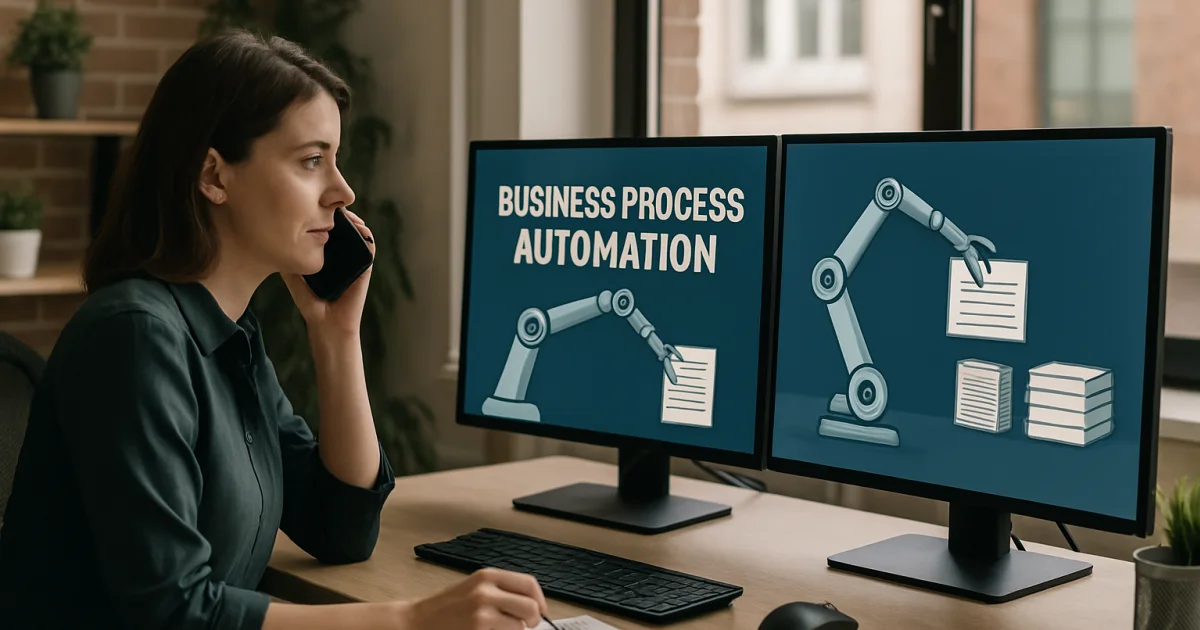
Artificial intelligence is revolutionizing how small businesses operate, offering unprecedented opportunities to automate processes, enhance customer experiences, and drive growth. The question isn't whether AI will impact your business, but how quickly you can harness its power to stay competitive.
Understanding AI's Impact on Small Business Operations
Small businesses today face increasing pressure to deliver exceptional customer service while managing limited resources and tight budgets. AI technology levels the playing field by automating routine tasks, analyzing customer data, and providing insights that were once available only to large corporations. According to McKinsey's research, businesses implementing AI solutions see productivity gains of 20-25% on average. This transformation allows business owners to focus on strategic growth initiatives rather than getting bogged down in administrative tasks.
The beauty of modern AI lies in its accessibility and ease of implementation. Gone are the days when artificial intelligence required massive IT departments and million-dollar budgets. Today's automation solutions are designed specifically for small businesses, offering plug-and-play functionality that can be deployed within days rather than months. From chatbots that handle customer inquiries 24/7 to inventory management systems that predict demand patterns, AI tools are becoming as essential as email and accounting software.
Key Areas Where AI Transforms Small Business Efficiency
Customer service represents one of the most impactful areas for AI implementation in small businesses. Intelligent chatbots can handle up to 80% of routine customer inquiries, freeing up your team to focus on complex issues that require human touch. These systems learn from every interaction, becoming more effective over time while maintaining consistent, professional responses that enhance your brand reputation. The result is faster response times, improved customer satisfaction, and reduced operational costs.
Sales and marketing automation through AI delivers remarkable results for businesses willing to embrace the technology. AI-powered systems can analyze customer behavior patterns, predict purchase likelihood, and personalize marketing messages for each prospect. HubSpot research shows that businesses using AI for marketing see 37% higher conversion rates and 52% faster sales cycles. Understanding AI implementation in these areas can transform your revenue generation capabilities overnight.
Financial management and accounting processes benefit tremendously from AI automation. Smart systems can categorize expenses, detect anomalies in spending patterns, and generate financial reports automatically. These tools reduce human error, ensure compliance with tax regulations, and provide real-time insights into cash flow and profitability. Many small business owners report saving 10-15 hours per week on bookkeeping tasks alone.
Overcoming Common AI Implementation Challenges
Many small business owners hesitate to adopt AI due to misconceptions about complexity and cost. The reality is that modern AI solutions are designed with user-friendly interfaces that require minimal technical expertise. Most platforms offer comprehensive onboarding support, training resources, and customer service to ensure smooth implementation. The key is starting with one specific use case rather than trying to automate everything at once.
Data security concerns often top the list of AI implementation worries, but reputable AI providers actually enhance security through advanced encryption and monitoring capabilities. These systems can detect unusual patterns and potential security threats faster than human oversight alone. Our success stories demonstrate how businesses across various industries have successfully implemented AI while maintaining the highest security standards.
Budget constraints shouldn't prevent small businesses from exploring AI solutions. Many providers offer scalable pricing models that grow with your business, allowing you to start small and expand as you see results. The return on investment typically becomes apparent within the first few months through reduced labor costs, increased efficiency, and improved customer satisfaction scores.
Measuring ROI and Success Metrics
Tracking the impact of AI implementation requires establishing clear baseline metrics before deployment. Key performance indicators might include customer response times, employee productivity hours, error rates in data processing, and customer satisfaction scores. Gartner research indicates that businesses with structured measurement approaches see 23% better AI outcomes than those without clear metrics.
The most successful AI implementations focus on solving specific business problems rather than adopting technology for its own sake. Whether you're looking to reduce customer service costs, increase sales conversion rates, or streamline operations, defining success metrics upfront ensures you can quantify the value AI brings to your organization. Regular monitoring and adjustment of these systems maximize their effectiveness over time.
Long-term success with AI requires ongoing optimization and expansion of use cases. Start with your most pressing business challenge, measure results, and then gradually expand AI implementation to other areas of your operation. This approach minimizes risk while building internal confidence and expertise with the technology.
Future-Proofing Your Business with AI
The competitive landscape is shifting rapidly as more businesses adopt AI technologies. Companies that delay implementation risk falling behind competitors who are already leveraging AI for better customer experiences, faster operations, and data-driven decision making. Early adopters consistently report competitive advantages that compound over time, making it increasingly difficult for late adopters to catch up.
Building AI capabilities today positions your business for emerging opportunities and market changes. As these technologies continue advancing, businesses with existing AI infrastructure can adapt more quickly to new tools and capabilities. This agility becomes especially valuable during economic uncertainty or sudden market shifts where operational efficiency and customer satisfaction become critical differentiators.
The investment in AI pays dividends beyond immediate operational improvements. Employees develop new skills, processes become more scalable, and decision-making improves through access to better data insights. These benefits create a foundation for sustainable growth that traditional approaches simply cannot match. Understanding our approach to AI transformation helps business owners see the long-term value beyond short-term gains.
Frequently Asked Questions
How much does it cost to implement AI in a small business?
AI implementation costs vary widely depending on your specific needs and chosen solutions. Many small businesses start with monthly subscriptions ranging from $50-500 per month for basic automation tools. More comprehensive systems might require initial setup investments of $2,000-10,000, but these typically pay for themselves within 6-12 months through improved efficiency and reduced labor costs.
Will AI replace my employees?
AI is designed to augment human capabilities rather than replace employees entirely. Most successful implementations free up staff time from routine tasks so they can focus on higher-value activities like customer relationship building, strategic planning, and creative problem-solving. This typically leads to job enrichment and increased employee satisfaction rather than job elimination.
How long does it take to see results from AI implementation?
Most businesses begin seeing measurable improvements within 30-60 days of implementation. Simple automation tools like chatbots and email marketing AI can show results within weeks. More complex systems involving data analysis and predictive capabilities may take 90-120 days to reach full effectiveness as they learn from your business patterns.
Do I need technical expertise to use AI tools?
Modern AI solutions are designed for business users, not programmers. Most platforms feature intuitive drag-and-drop interfaces, pre-built templates, and guided setup processes. While some technical knowledge can be helpful, it's not required for most small business AI applications.
How secure is my business data with AI systems?
Reputable AI providers implement enterprise-grade security measures including data encryption, secure cloud storage, and regular security audits. Many AI systems actually improve data security by detecting unusual patterns and potential threats faster than traditional methods. Always verify that your chosen provider complies with relevant industry standards and regulations.
What's the best way to get started with AI?
Start by identifying your biggest operational pain point, whether it's customer service, lead generation, or administrative tasks. Choose one specific area and implement a focused AI solution rather than trying to automate everything at once. Check our pricing options to find a solution that fits your budget and needs.
Can AI help with regulatory compliance and reporting?
Yes, AI excels at maintaining consistent compliance by automatically categorizing transactions, flagging potential issues, and generating required reports. These systems reduce human error in compliance processes and can adapt to changing regulations more quickly than manual systems. Many small businesses find AI particularly valuable for tax preparation, financial reporting, and industry-specific compliance requirements.
Getting Started
The journey toward AI-powered business transformation begins with a single step, and that step doesn't have to be overwhelming or expensive. Whether you're looking to automate customer service, streamline operations, or enhance your marketing efforts, the right AI solution can deliver measurable results within weeks. Don't let your competitors gain an advantage while you wait – explore our comprehensive automation solutions today and discover how AI can transform your business operations, reduce costs, and accelerate growth in ways you never thought possible.
Brandon Hufstetler
Principal and CEO of Autonomous Retail Technology
Brandon Hufstetler is an AI strategist and executive dedicated to helping businesses connect technology, data, and strategy to achieve real growth in the modern business era. As the Principal and CEO of Autonomous Retail Technology, he leads initiatives that use AI to streamline operations, enhance decision-making, and scale business impact. With nearly 25 years of experience spanning startups, scaling ventures, and large enterprises, Brandon has built a reputation for bridging the gap between innovation and execution. His approach blends business acumen with deep technical insight, enabling organizations to embrace AI in ways that are both responsible and transformative. Before founding Autonomous Retail Technology, Brandon spent more than a decade in senior leadership roles overseeing digital transformation, business development, and enterprise analytics. He is passionate about empowering leaders to navigate the evolving AI landscape with confidence, creativity, and measurable outcomes.
Ready to Automate Your Business?
Let's discuss how automation can transform your operations.
Book a Free Consultation