Sales Automation: How to Scale Your Revenue Without Hiring More Sales Staff
Smart businesses are leveraging sales automation to achieve explosive growth without the overhead of expanding their sales teams. Learn how to implement automated workflows, nurture leads efficiently, and scale your revenue using cutting-edge autonomous technology solutions.
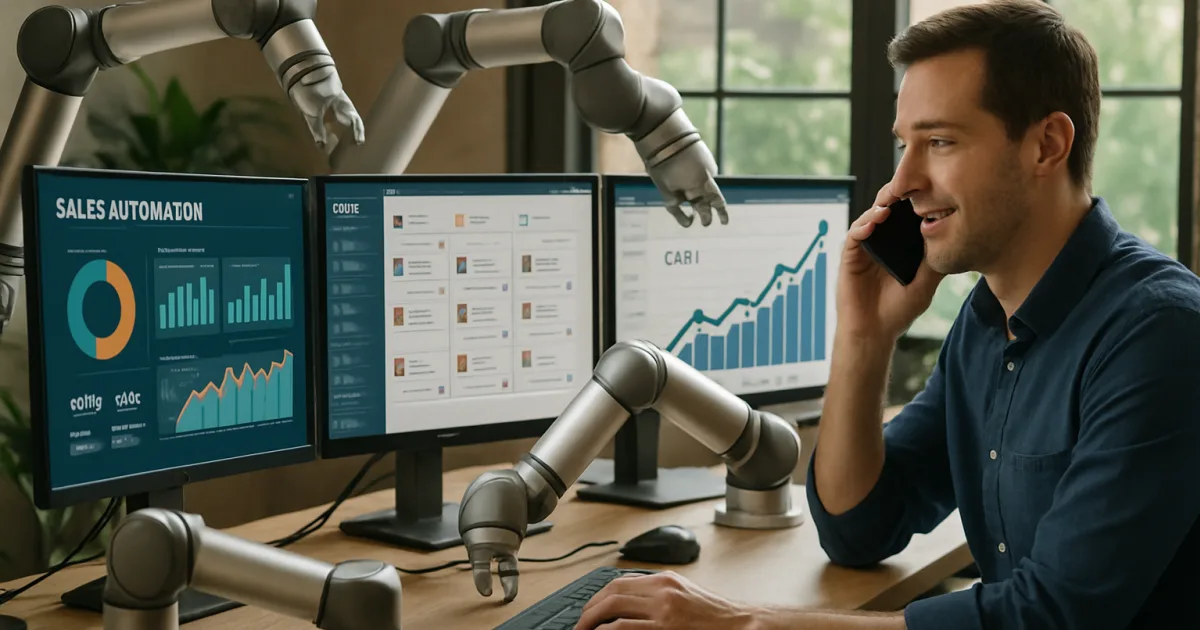
Small businesses today face increasing pressure to streamline operations while managing growing customer expectations and limited resources. Autonomous technology and AI automation offer powerful solutions to help businesses work smarter, reduce manual tasks, and scale efficiently without breaking the budget.
Understanding Autonomous Technology for Small Business
Autonomous technology refers to systems that can operate independently with minimal human intervention, using artificial intelligence to make decisions and complete tasks. For small businesses, this doesn't mean replacing human workers entirely, but rather automating repetitive processes that consume valuable time and resources. Think of it as having a digital assistant that never sleeps, handling routine tasks like data entry, customer inquiries, appointment scheduling, and inventory management. According to McKinsey research, businesses that implement AI automation can reduce operational costs by up to 30% while improving accuracy and response times.
The key advantage for small businesses lies in the technology's ability to level the playing field with larger competitors. While big corporations have teams of specialists handling various operational tasks, small businesses can now achieve similar efficiency through intelligent automation. Our automation solutions are specifically designed for small business needs, focusing on high-impact areas that deliver immediate results. This technology enables business owners to focus on strategic growth activities rather than getting bogged down in daily administrative tasks.
Key Benefits of AI Automation for Small Businesses
The most immediate benefit small businesses experience with AI automation is significant time savings across multiple operational areas. Customer service automation can handle up to 80% of routine inquiries, freeing up staff to focus on complex customer needs and relationship building. Financial processes like invoice processing, expense tracking, and basic bookkeeping can be automated, reducing errors and ensuring consistent cash flow management. Marketing automation helps businesses maintain consistent communication with customers through personalized email campaigns, social media posting, and lead nurturing sequences.
Cost reduction represents another major advantage, as automation eliminates the need for additional staff to handle growing workloads. Small businesses often struggle with the decision of when to hire new employees, but automation provides a scalable alternative that grows with the business. Quality and consistency improvements are equally important, as automated systems don't have bad days or make human errors in data entry or customer communications. Our success stories demonstrate how businesses achieve 40-60% reduction in processing time while improving accuracy rates to over 99%.
Common Applications Across Different Industries
Retail businesses benefit tremendously from inventory management automation, which tracks stock levels, predicts demand patterns, and automatically reorders products before stockouts occur. Point-of-sale integration with automated systems provides real-time insights into sales trends, customer preferences, and profit margins. E-commerce businesses can automate order processing, shipping notifications, and customer follow-up sequences, creating a seamless customer experience from purchase to delivery. Restaurant and food service businesses use automation for online ordering, delivery coordination, and inventory tracking to reduce waste and improve profitability.
Professional service businesses like accounting firms, law offices, and consulting companies automate client onboarding, document management, and appointment scheduling. Healthcare practices implement automated patient reminders, insurance verification, and basic diagnostic data collection to improve patient flow and reduce administrative burden. Manufacturing and distribution businesses automate quality control processes, supply chain management, and production scheduling to maintain consistent output while minimizing waste. Gartner reports that 80% of executives believe automation can be applied to virtually any business decision.
Implementation Strategies That Actually Work
Successful automation implementation starts with identifying the right processes to automate, focusing on repetitive, rule-based tasks that consume significant time but don't require complex decision-making. Begin with one or two high-impact areas rather than trying to automate everything at once, allowing your team to adapt gradually while seeing immediate benefits. Document current processes thoroughly before automation to ensure the technology replicates and improves existing workflows rather than creating new complications. Our AI implementation approach emphasizes this gradual, strategic rollout to maximize success rates.
Training and change management are crucial components often overlooked by small businesses eager to see immediate results. Involve your team in the selection and setup process, addressing concerns about job security by emphasizing how automation will eliminate tedious tasks and allow them to focus on more interesting, valuable work. Set realistic expectations for implementation timelines and initial results, as most automation systems require 30-60 days to reach optimal performance. Measure success through specific metrics like time saved, error reduction, and cost savings rather than subjective impressions of improved efficiency.
Overcoming Common Concerns and Obstacles
Budget constraints top the list of concerns for small business owners considering automation, but modern solutions offer flexible pricing models that scale with business size and needs. Many automation tools provide immediate ROI through reduced labor costs and improved efficiency, often paying for themselves within 3-6 months. Start-up costs can be minimized by choosing cloud-based solutions that don't require significant hardware investments or long-term contracts. Our pricing information shows how businesses can start with basic automation packages and expand as they see results.
Technical complexity fears often prevent business owners from exploring automation options, but today's solutions are designed for non-technical users with intuitive interfaces and comprehensive support. Many systems offer drag-and-drop setup processes and pre-built templates for common business scenarios, eliminating the need for programming knowledge or IT expertise. Security concerns about data protection and system reliability are addressed through enterprise-grade encryption, regular backups, and compliance with industry standards. Forrester research indicates that modern automation platforms maintain 99.9% uptime while providing better data security than manual processes.
Measuring Success and ROI
Effective measurement starts with establishing baseline metrics before implementing automation, including current processing times, error rates, labor costs, and customer satisfaction scores. Track both quantitative metrics like cost savings and processing speed improvements, as well as qualitative benefits such as employee satisfaction and customer experience enhancements. Most small businesses see measurable improvements within the first month, with full ROI typically achieved within six months of implementation. Regular monitoring and adjustment ensure automation systems continue delivering optimal results as business needs evolve.
Key performance indicators should align with specific business goals, whether that's reducing customer response times, increasing order processing capacity, or improving data accuracy. Monthly reviews help identify opportunities for expanding automation to additional processes or fine-tuning existing systems for better performance. Document success stories and share results with your team to maintain enthusiasm and identify new automation opportunities. Businesses that actively measure and optimize their automation systems achieve 3x better results than those that implement without ongoing monitoring.
Frequently Asked Questions
How much does business automation typically cost for small businesses?
Most small business automation solutions range from $50-500 per month depending on the complexity and number of processes automated. Many businesses see positive ROI within 3-6 months through reduced labor costs and improved efficiency. Cloud-based solutions eliminate upfront hardware costs, making automation accessible for businesses of all sizes.
Will automation eliminate jobs at my small business?
Automation typically eliminates tedious, repetitive tasks rather than entire jobs, allowing employees to focus on higher-value activities like customer relationships and strategic planning. Most small businesses find that automation enables growth without proportional increases in staffing costs. The goal is to augment human capabilities rather than replace workers entirely.
How long does it take to implement business automation?
Basic automation implementations typically take 2-4 weeks for initial setup and another 2-4 weeks for optimization and team training. More complex systems may require 2-3 months for full implementation. Starting with simple processes allows businesses to see quick wins while building confidence for larger automation projects.
What business processes should I automate first?
Start with repetitive, rule-based processes that consume significant time but don't require complex decision-making, such as data entry, appointment scheduling, or basic customer inquiries. Email marketing, invoice processing, and inventory tracking are also excellent starting points. Focus on processes that directly impact customer experience or operational efficiency for maximum initial impact.
Is my small business too small for automation?
No business is too small for automation if it involves repetitive tasks that consume valuable time. Even single-person businesses benefit from automated scheduling, customer communications, and basic bookkeeping. Modern automation tools scale to fit any business size, often providing the biggest relative impact for smaller operations.
How secure is business automation technology?
Modern automation platforms use enterprise-grade security including data encryption, secure access controls, and regular security audits. Cloud-based solutions often provide better security than on-premise systems through professional monitoring and automatic updates. Most platforms comply with industry standards like SOC 2 and maintain comprehensive backup systems.
Can I customize automation to fit my specific business needs?
Yes, most modern automation platforms offer extensive customization options through user-friendly interfaces that don't require programming skills. You can create custom workflows, set specific triggers and conditions, and integrate with existing business tools. Our consultation services help businesses design automation solutions tailored to their unique requirements and industry needs.
Getting Started
Ready to transform your business operations with intelligent automation? The key is starting with a clear understanding of your current challenges and automation opportunities. Our team specializes in helping small businesses identify high-impact automation projects that deliver immediate results while building a foundation for future growth. Don't let manual processes hold your business back when proven automation solutions can free up your time and resources for strategic activities. Explore our automation solutions today and discover how autonomous technology can give your business the competitive edge it needs to thrive in today's market.
Brandon Hufstetler
Principal and CEO of Autonomous Retail Technology
Brandon Hufstetler is an AI strategist and executive dedicated to helping businesses connect technology, data, and strategy to achieve real growth in the modern business era. As the Principal and CEO of Autonomous Retail Technology, he leads initiatives that use AI to streamline operations, enhance decision-making, and scale business impact. With nearly 25 years of experience spanning startups, scaling ventures, and large enterprises, Brandon has built a reputation for bridging the gap between innovation and execution. His approach blends business acumen with deep technical insight, enabling organizations to embrace AI in ways that are both responsible and transformative. Before founding Autonomous Retail Technology, Brandon spent more than a decade in senior leadership roles overseeing digital transformation, business development, and enterprise analytics. He is passionate about empowering leaders to navigate the evolving AI landscape with confidence, creativity, and measurable outcomes.
Ready to Automate Your Business?
Let's discuss how automation can transform your operations.
Book a Free Consultation